![[citation needed]](https://substackcdn.com/image/fetch/$s_!_O_L!,w_120,h_120,c_fill,f_webp,q_auto:good,fl_progressive:steep/https%3A%2F%2Fsubstack-post-media.s3.amazonaws.com%2Fpublic%2Fimages%2F42798cea-a8c2-4a38-9e58-0dbb4761528a_1080x1080.png)
It's Today
International Men's Day: How patriarchy built male loneliness and why dismantling it frees everyone

Note: If you are a man and are looking for support, Andy’s Man Club is a fantastic organisation that has groups all over the UK.
Every year on 8 March, as the world marks International Women’s Day, the same pattern appears. Social media fills with men asking when International Men’s Day is. Often it is framed as a gotcha, a test of fairness, rather than a genuine question. It happens so reliably that comedian Richard Herring started spending International Men’s Day replying to those men to tell them that it is, in fact, on 19th November. He wrote about it in a piece for his site and described just how often the question is asked.¹
What happens when 19th November actually arrives is much quieter. Many of the men who were loudly concerned about equality a few months earlier do not engage at all. They do not ask what International Men’s Day is for. They do not look for services or support aimed at men. The sense of unfairness fades until the next International Women’s Day, when the cycle begins again.
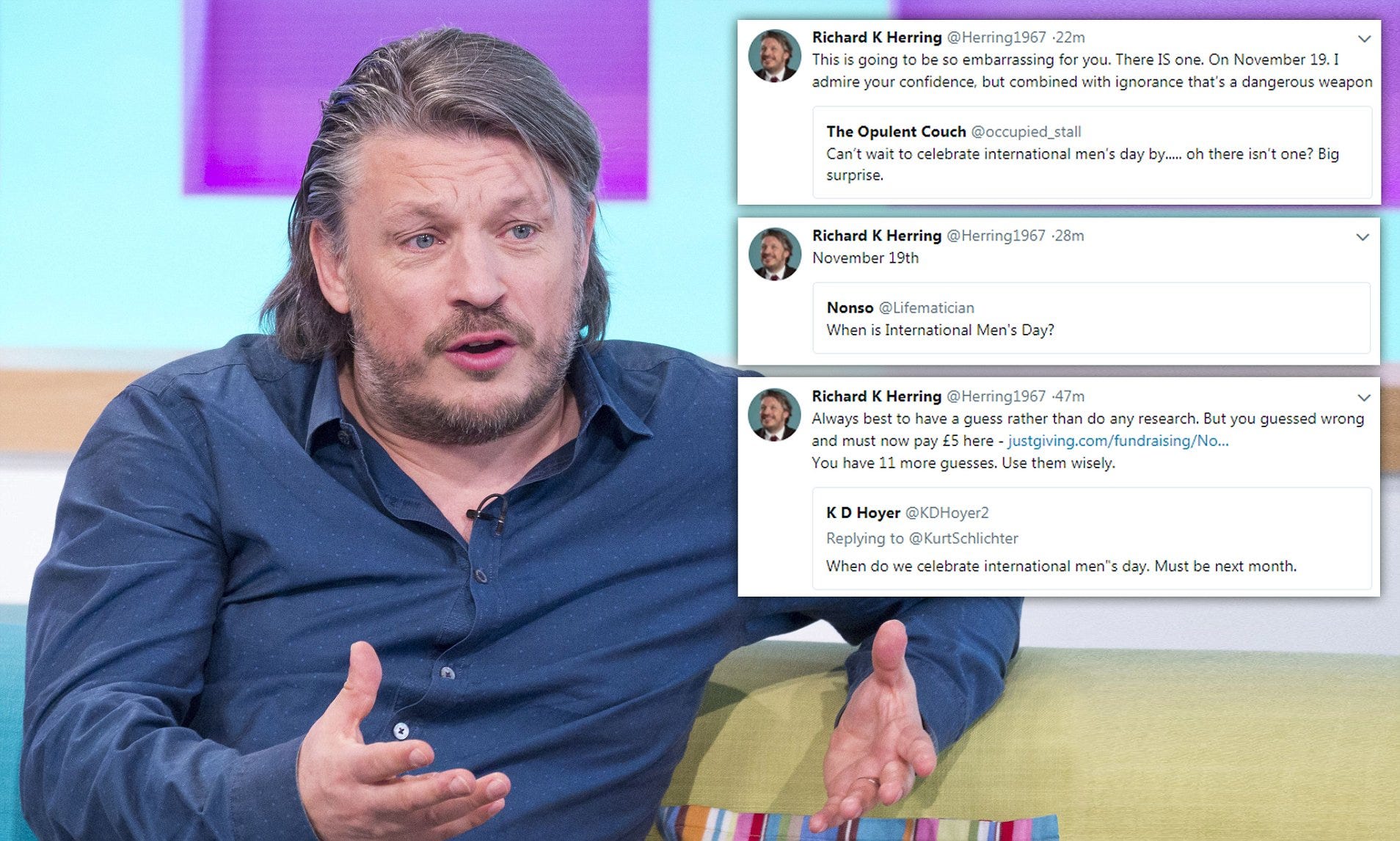
If you recognise any part of that, this article is aimed at you. Not to shame you, but to name something that is already happening around you. Men are lonely. In recent UK data, around 27 percent of adults reported feeling lonely always, often, or some of the time.² That is a broad figure across genders, but when we look at harm, the picture shifts. In the latest UK suicide figures, the male suicide rate is more than three times the female rate, at 17.1 deaths per 100,000 people compared with 5.6 for women.³
At the same time, men are less likely to reach out when they struggle. A Samaritans survey found that men in rural areas are less likely than women to talk to someone when their mental health is poor. Only 43 percent of men in rural communities said they would seek support, compared with 60 percent of women.⁴ This combination of higher risk and lower help seeking is at the heart of what people now call the male loneliness epidemic.
It is tempting to blame this on women, feminism, or a culture that finally pays attention to International Women’s Day. That would be easier than looking at the real cause. The truth is that men built and maintained a system that rewards dominance and punishes vulnerability. Boys and men are taught to suppress emotion, compete with each other, and base their worth on power instead of connection. Patriarchy promised status and control. It quietly delivered isolation instead.
This piece follows on from an earlier argument in my previous article, Have the Difficult Conversation, which looked at how men need to face the ways patriarchy harms them before they can meaningfully support women who live under the same system.⁵ This article takes the next step. If men want companionship, trust, and genuine community, that change will not come from blaming women. It will come from dismantling the system that made it so hard for men to connect in the first place.
International Men’s Day is not a punchline or a counterweight to International Women’s Day. It is a chance for men to look directly at loneliness, violence, and power, and to decide what they are willing to do about them. If you want to know when International Men’s Day is, it is today. The real question is what you are prepared to change when it comes around.
The shape of the crisis
If International Men’s Day is going to mean anything, it has to start with what men are actually facing. Male loneliness is not a vibe or a meme. It is a pattern that shows up clearly in both mental health and social connection data.
On the mental health side, the charity Mind summarises NHS evidence by stating that around 1 in 5 adults in England has a common mental health condition, with about 24 percent of women and 15 percent of men affected in any given week.¹ Men are not immune. They simply show distress differently. The Mental Health Foundation notes that three times as many men as women die by suicide in the UK, and that three quarters of deaths registered as suicide are among men.²
This is mirrored in other summaries of men’s health. Mental Health UK reports that 12.5 percent of men in England have a mental health disorder, and confirms that men are around three times more likely to die by suicide than women.³ Bupa describes suicide as the most common cause of death for men under 50 in England and Wales.⁴ This is what “crisis” actually looks like when you zoom out from individual stories.
Then there is the friendship piece. A 2019 YouGov poll, reported by outlets like BBC Science Focus and the Evening Standard, found that about one in five men in the UK has no close friends at all, and around one third say they do not have a best friend.⁵ ⁶ These findings are not fringe. They are echoed in more recent commentary that uses the same dataset to describe a “silent crisis of loneliness” for men.⁷ Men are more likely than women to report having no one they can turn to when life becomes difficult.
Taken together, this explains why the phrase “male loneliness epidemic” has stuck. You have a group that is statistically more likely to die by suicide, more likely to be socially isolated, and less likely to seek help. You also have a culture that has not given men many tools for talking about fear, shame, or sadness without feeling like they are failing at being a man.
The crisis is structural. It is about how men are raised, how they are rewarded, and how they are punished for stepping outside a narrow script. International Men’s Day is meant to be one space where that script can be examined and rewritten. Whether it becomes that depends on what men decide to do with it.
The system that built it
When we talk about male loneliness, it is easy to treat it as a sad coincidence. A collection of individual men who somehow slipped through the net. But the pattern is too consistent for that. What we are seeing is not only personal bad luck. It is the result of a system.
Patriarchy is the name we give that system. Plan International UK describes patriarchy as a social system where men have primary power and shape laws, culture and opportunities, and where this structure affects education, work, health and safety for everyone.¹ In other words, it is a way of organising society that automatically gives men advantages over women and anyone who does not fit a narrow idea of masculinity.
That advantage is real. If you are a man, you are more likely to be taken seriously in some rooms, more likely to be believed, more likely to move through public space without fear. You may not feel powerful, but you still benefit from rules written with you as the default.
At the same time, patriarchy comes with a script about how men should behave. Simply Psychology explains patriarchal ideology as the idea that men should have more power, dominance and privilege than women, and defines patriarchy as a system where men hold primary power in both personal life and the workplace.² Those ideas filter down into everyday messages such as “men should appear strong”, “men should deal with problems themselves”, and “men should not show weakness”. A mental health leaflet from the University of Wolverhampton lists beliefs like “Men are meant to deal with problems themselves” and “Men should appear strong, intelligent and capable” as common masculine norms that can stop men seeking help.³
The UK Government Equalities Office commissioned work on these norms in a report called “Changing gender norms: engaging with men and boys”. The report looks at how expectations around masculinity in the UK shape behaviour and how those expectations can be challenged.⁴ The detail sits mostly with practitioners, but the message is simple. If you teach boys that they must be tough, in control and emotionally closed to count as men, you create adults who struggle to form safe, honest relationships.
This is how we get to a male loneliness epidemic inside a male dominated system. Men sit at the top of many formal hierarchies, but they are often at the bottom when it comes to emotional literacy, social support and the ability to ask for help. The same norms that help some men win at competition also cut them off from care.
So when we say that patriarchy built this crisis, we are not letting anyone off the hook. We are saying that men as a group created and maintained a system that benefits them materially and politically, but starves them emotionally. Men did not choose every detail of that system, but they inherit it and they pass it on unless they actively decide to do something different.
Men: This is an invitation to understand that your loneliness is not random. It is connected to a wider structure that you have the power to question and to change. The system built it. You can help dismantle it.
It is all men - the continuum no one wants to see
Men reading this often say “not all men”. And yes, technically you’re right. Not every man commits violence. But that response misses the point. Because the real issue is less about “which men” and more about how many men support, enable or benefit from a system in which violence, isolation and silence are normal.
Think of it as a spectrum. At one end are serial offenders, perpetrators of repeated violence. Fewer men occupy this space, but the harm they do is brutal and visible. Below them are men who commit a one-time act of violence or coercion. They still cause real damage. Then comes a large middle zone of men who don’t commit acts of violence but who laugh off jokes about drunk women, high-five a mate’s sexual bragging, or shrug when a friend says something creepy. Their silence is not neutral. It is signal and support for the behaviour that sits above. Beneath that you find men who simply don’t know how bad things are, are unaware of the emotional rules they live by, or choose passive isolation over confrontation. Only a small minority of men visibly stand up, speak out and act publicly against the culture of violence and isolation. And because they do, women see them. The rest remain invisible or ambiguous.
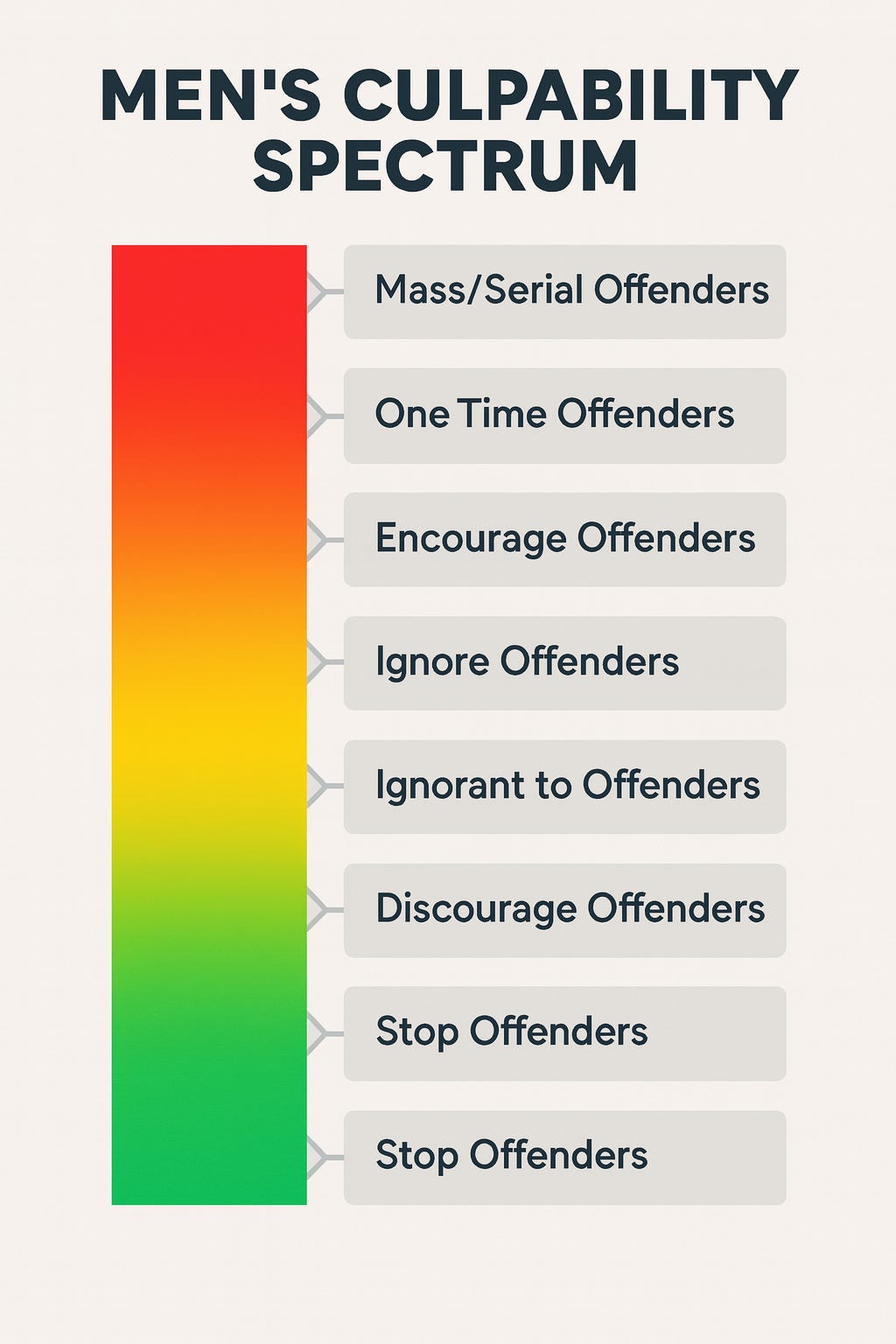
To make this clearer: globally nearly one in three women have experienced physical or sexual violence at least once in their life.¹ According to the World Health Organization (WHO), such violence is overwhelmingly carried out by men against women.² In the UK one survey found that in the year ending March 2022 about 3.3 % of women and 1.2 % of men aged 16 and over had experienced sexual assault, including attempts.³ That giant gap does not mean only a few men are responsible. It means a structure exists where the risk falls on women, and the behaviours fall to men.
Meanwhile, research on bystander behaviour shows a hard truth. A UK evidence review noted that men who socially support attitudes accepting of sexual violence were more likely to be involved in offending, and that a culture of peer-norms plays a key role in whether violence occurs.⁴ In other words, the problem is not just offenders and victims. It is the social web that surrounds those offenders and sometimes protects them.
So when women say “it’s all men”, they are not claiming each man has committed a crime. Their observation is that almost every man lives inside a system where male violence, male silence and male loneliness are connected. If you are a man reading this, these are the questions you now need to face: do you allow the jokes? Do you shrug and walk away? Do you remain quiet when something feels wrong? Or do you become the man who says something in the room? The gap between. That gap is where change begins.
This isn’t about guilt or shame for being born male. It is about responsibility. If you don’t recognise the continuum, you risk being part of the problem even when you think you are not. If you do recognise it, you step into the solution.
The Cultural Mirror - How We Got Here
There is a paradox in the male loneliness epidemic: while men appear to sit at the top of many power structures, they often find themselves isolated. Culture has not just reflected this; it has enabled it. To see how, look at how men are being shaped by digital spaces, social changes and shifting gender norms.
One of the most visible landscapes for this is what is called the manosphere - online communities of men who feel disaffected, excluded or angry. A major report commissioned by Ofcom found that while not all men in these spaces become extremists, the communities offer identity, connection and meaning where real-world friendship networks often fail. ¹ The report warned that for socially isolated men, the promise of belonging in these digital tribes is powerful - and so is the risk.
Closely tied to this is the rise of what are called incel community or involuntary celibate subcultures. These are mostly online groups of men who believe they are excluded from sexual or romantic relationships, often viewing women, society or themselves as to blame. The UK government has highlighted this as a risk factor for male violence and isolation. ² When you see men blaming intimacy, friendship or connection for their pain, you see how loneliness bleeds into aggression.
Across the world two other trends speak to the same process - men losing their traditional social anchors while culture moves on. In South Korea and beyond the 4B movement has emerged among women who pledge no sex, no dating, no marriage and no childbirth with men. ³ While the movement itself is not massive, its symbolism is clear: some women are voting with their lives and bodies against a system that they say fails them, and men are left watching. Whether this applies in the UK or not, the signal is global: when men do not evolve, culture around them does.
At the same time the pandemic exposed how fragile male social worlds have become. The shutdown of communal spaces like pubs, gyms, sports clubs and workplaces hit men particularly hard. Many men do not have the emotional language or social infrastructure to rebuild those connections when life goes back to “normal”. The result is a generation acutely aware of what they lack - a community, a friend, a safe place to talk.
All of this points to the bitter truth: the loneliness epidemic and the male‐violence crisis are two faces of the same cultural problem. When men are trained to win but not to belong, when being tough means being alone and being silent means being safe, the only way out is cultural reform. This is not a polite suggestion but a real call. The culture that shaped you is the one you must reshape. Because you cannot disconnect the loneliness from the system. You cannot heal connection without confronting inequality.
How patriarchy punishes men too
To understand the male loneliness epidemic, we need to be honest about something that is often left out. The same system that harms women also harms men. Patriarchy does not only hand out power. It also sets men up to fail emotionally.
Mental Health UK summarises the picture clearly. It notes that 12.5 percent of men in England have a mental health disorder and that men are around three times more likely to die by suicide than women.¹ The charity also points out that men are more likely to use alcohol and drugs to cope and to behave in ways that put their health at risk. These are not random choices. They are shaped by expectations about how men should handle pain.
The Mental Health Foundation describes how men are far more likely than women to go missing, sleep rough, become dependent on alcohol or use drugs frequently.² It highlights that men often feel under pressure to be the main earner, to stay in control and to avoid showing vulnerability. When those expectations clash with reality, some men withdraw, some lash out and many stay silent.
Economic pressure adds another layer. A separate report from the Mental Health Foundation explains that poverty increases the risk of mental health problems and that mental ill health can also make poverty harder to escape.³ While this applies to all genders, men who have been taught to tie their worth to income and status can experience this as a direct blow to their identity. If you believe your value lies only in being strong and providing, any setback can feel like proof that you have failed at being a man.
Loneliness then amplifies everything. The World Health Organization estimates that about 16 percent of people worldwide experience loneliness and notes that social isolation and loneliness have a serious impact on health, quality of life and longevity.⁴ A review from Harvard Medical School reports that loneliness and social isolation are associated with around a 29 percent increased risk of heart attack and a 32 percent increased risk of stroke, with risk levels similar to that of light smoking or obesity.⁵ The US Surgeon General has gone as far as to describe loneliness and isolation as a public health crisis in its own right.⁶
When you combine gendered expectations, financial stress and health risks, you start to see how patriarchy punishes men. It tells men they must be strong, then gives them no tools for being soft. It tells them they must cope, then mocks them when they seek help. It tells them their job is to provide, then offers no alternative story when work or money collapse. The result is men who are statistically more likely to die by suicide, more likely to turn to substances and more likely to be isolated.
If you feel lonely or ashamed of struggling, this is not because you have failed some personal test. It is because you grew up in a culture that made it hard for you to be human. That system is patriarchy. It hurts women in obvious ways. It hurts men in quieter, more private ways. Ending it is not a favour to women. It is a route to saving your own life too.
The way forward - what men can actually do
If you’ve read this far, you already know that feeling lonely and powerless as a man isn’t just bad luck. It’s part of a system you can change. And change starts with action.
1. Become a visible ally
The charity White Ribbon UK leads the campaign in England and Wales asking men to commit publicly to never use, excuse or remain silent about men’s violence against women and girls.¹ Making that visible pledge helps shift culture - because when men act as bystanders rather than spectators, it changes the script. Wearing a white ribbon, talking openly about behaviour, making the promise - these are not symbolic only. They are the first step to habit.
2. Talk with men about men’s behaviour
It’s not enough to live in isolation. The research shows that men’s habits, peer-norms and silence protect harmful behaviour.² Start conversations: ask friends how they feel about sexist jokes, high-five bragging, emotional isolation. Bring your experience into the room. Invite men to break the continuum. A friend who speaks up can open the door for others.
3. Organise or join a men’s group for connection
Loneliness thrives when you feel you must do it alone. Men’s groups provide a space to speak, listen and connect. It could be a local community circle, a book club, a walking group, or an informal gathering focused on openness rather than competition. It is where you replace silence with stories and isolation with accountability.
4. Learn the emotional language
You would not learn to code in silence - so why assume you can learn to feel alone? Read, train, explore therapy or peer-work. Men’s emotional literacy is a safeguarding issue for everyone. When you speak your needs, you change the model for those you know.
5. Understand you benefit, thus you have responsibility
Men benefit from the system whether they realise it or not. But benefit comes with responsibility. Stand against behaviours that keep you lonely and women unsafe. The steps above are not only about keeping others safe - they help rebuild your own connection, your own health and your own sense of purpose.
The low bar
If you’ve ever heard a woman say “at least he doesn’t hit me,” you’ve heard the low bar in action. It’s a telling phrase because it reveals how far expectations have sunk and how little has changed for men’s emotional lives in parallel.
Research in the UK confirms this dynamic. A survey by the charity Future Men found that 52 % of men feel society’s expectations weigh heavily on them, and 51 % of young men believe “crying in front of others” would make them feel less masculine.¹ Feelings of inadequacy are chronic rather than exceptional. The bar isn’t just low - it doesn’t exist for real connection.
Meanwhile, discussions about masculinity show that men are growing more aware of the constraints. A study by Ipsos and King’s College London reported that 30 % of young men believe it will be harder to be a man than a woman in 20 years’ time.² When prestige and power are being questioned, what remains? For many, the answer is silence.
These conditions produce a tricky irony: men may hold public power yet privately feel powerless. They benefit from the system at the surface but suffer from its emotional cost deeper down. The systems that reward dominance give no script for openness or vulnerability. So the low bar remains in place - a man avoids violence, pays the bills, doesn’t talk about feelings - and gets labelled “decent”.
In that “decent” label lies a trap. If the expectation is simply “not horrible”, what happens to men who want to be generous, connected, emotionally available? They are swimming upstream. The culture is not built to reward them. Instead they remain invisible. And that invisibility feeds loneliness.
The bar isn’t there for you to clear by default. You’re not starting at a baseline of emotional safety, connection or empathy. You have to build it. You have to raise it. Because a standard so low is still a prison.
Shared Liberation - The End Goal
The final word isn’t about punishing men, and it isn’t about elevating women at the expense of men. The goal is liberation. When patriarchy falls, everyone gains. The question is: which side of history do you want to be on?
Feminist thought and empirical studies both point to one truth: men do benefit from patriarchy, yet the structure also confines them. An article in Alliance Magazine argues that feminism is liberating for men precisely because it allows men to discard the narrow roles patriarchy imposed on them.¹ When men join in shared liberation, they reclaim parts of themselves they were taught to suppress.
This is not charity. It is shared interest. A piece in Mach Chronicle summarises this: “Dismantling the patriarchy not only limits the oppression of women but helps men forge meaningful relationships, expand their options in the workplace, and adapt to our evolving society”.² The people at the top of rigid systems often pay the highest price in loneliness, pressure and emotional cost.
Global institutions recognise this too. A Harvard Kennedy School article on autocracy and patriarchy states that deeply patriarchal systems restrict not only women but men who do not fit the traditional mould.³ If gender equity is pinned as “only women’s work”, men lose the chance to be allies and lose the chance to connect.
So here’s the practical takeaway: If you are a man reading this, your liberation is bound up with women’s. Your capacity to feel, to care, to connect and to be fully human depends on dismantling a system that boxed you into power without permission to be vulnerable. When you stand for equity, you are not giving up your manhood-you are reclaiming it.
Today, on International Men’s Day, you have a choice. Ask again “Where is my space?” or step into one that already exists: a space of responsibility, connection and change. Choose the work of building bridges, not walls. Choose the liberation that frees everyone.
References for Introduction
Richard Herring, ‘International Men’s Day - comment is free’, RichardHerring.com Journalism, 19 November 2015 https://www.richardherring.com/journalism/10321/international_mens_day_comment_is_free.html accessed 19 November 2025.
Office for National Statistics, ‘Public opinions and social trends, Great Britain: 13 December 2023 to 1 January 2024’, Office for National Statistics, 12 January 2024 https://www.ons.gov.uk/peoplepopulationandcommunity/wellbeing/bulletins/publicopinionsandsocialtrendsgreatbritain/13december2023to1january2024 accessed 19 November 2025.
Samaritans, ‘Latest suicide data’, Samaritans, 2025 https://www.samaritans.org/about-samaritans/research-policy/suicide-facts-and-figures/latest-suicide-data/ accessed 19 November 2025.
Samaritans, ‘Men in rural communities least likely to seek support when struggling to cope’, Samaritans, 1 March 2022 https://www.samaritans.org/news/men-in-rural-communities-least-likely-to-seek-support-when-struggling-to-cope/ accessed 19 November 2025.
Piper Dawes, ‘Have the Difficult Conversation’, [citation needed], 2024 https://citationneeded.substack.com/p/have-the-difficult-conversation accessed 19 November 2025.
References for The shape of the crisis
Mind, “Key facts and statistics about mental health”, Mind, 2024 https://www.mind.org.uk/information-support/types-of-mental-health-problems/mental-health-facts-and-statistics/ accessed 19 November 2025.
Mental Health Foundation, “Men and women: statistics”, Mental Health Foundation, 2023 https://www.mentalhealth.org.uk/explore-mental-health/statistics/men-women-statistics accessed 19 November 2025.
Mental Health UK, “Men’s mental health”, Mental Health UK, 2023 https://mentalhealth-uk.org/mens-mental-health/ accessed 19 November 2025.
Bupa, “Talking about men’s mental health”, Bupa, 2023 https://www.bupa.co.uk/newsroom/ourviews/mens-health-mental-health accessed 19 November 2025.
BBC Science Focus, “How loneliness is killing men”, Science Focus, 11 November 2022 https://www.sciencefocus.com/science/how-loneliness-is-killing-men accessed 19 November 2025.
Evening Standard, “Why do men find it so difficult to make new friends?”, Evening Standard, 9 October 2019 https://www.standard.co.uk/lifestyle/why-do-men-find-it-so-difficult-to-make-new-friends-a4257026.html accessed 19 November 2025.
Julia Samuel, “Let’s talk about men: the silent crisis of loneliness”, JuliaSamuel.co.uk, 28 June 2024 https://www.juliasamuel.co.uk/support-posts/lets-talk-about-men-the-silent-crisis-of-loneliness accessed 19 November 2025.
References for The system that built it
Plan International UK, “What is the patriarchy?”, Plan International UK, 2025 https://plan-uk.org/our-work/girls-rights/what-is-the-patriarchy accessed 19 November 2025.
Simply Psychology, “Patriarchal society according to feminism”, Simply Psychology, 13 February 2024 https://www.simplypsychology.org/patriarchal-society-feminism-definition.html accessed 19 November 2025.
University of Wolverhampton, “Self-help leaflets: Men and mental health”, University of Wolverhampton, undated https://www.wlv.ac.uk/current-students/student-support/mental-health-and-wellbeing-advice/self-help-leaflets/ accessed 19 November 2025.
Government Equalities Office, “Changing gender norms: engaging with men and boys”, GOV.UK, 15 January 2021 https://www.gov.uk/government/publications/changing-gender-norms-engaging-with-men-and-boys accessed 19 November 2025.
References for It is all men
UN Women, “Global database on violence against women and girls”, 2024 https://data.unwomen.org/global-database-on-violence-against-women accessed 19 November 2025.
World Health Organization, “Violence against women fact sheet”, 25 March 2024 https://www.who.int/news-room/fact-sheets/detail/violence-against-women accessed 19 November 2025.
Office for National Statistics, “Sexual offences victim characteristics, England and Wales: year ending March 2022”, 23 March 2023 https://www.ons.gov.uk/peoplepopulationandcommunity/crimeandjustice/articles/sexualoffencesvictimcharacteristicsenglandandwales/yearendingmarch2022 accessed 19 November 2025.
UK Government Home Office, “Evidence review: bystander intervention to prevent sexual and domestic violence in universities”, April 2016 https://assets.publishing.service.gov.uk/media/5a802686ed915d74e622cc3b/Evidence_review_bystander_intervention_to_prevent_sexual_and_domestic_violence_in_universities_11April2016.pdf accessed 19 November 2025.
References for The Cultural Mirror
Ofcom, “The Manosphere unmasked”, Ofcom, 13 June 2025 https://www.ofcom.org.uk/online-safety/protecting-children/the-manosphere-unmasked accessed 19 November 2025.
Home Office, “Predicting harm among incels (involuntary celibates): the roles of mental-health, ideological belief and social networking”, GOV.UK, 2024 https://www.gov.uk/government/publications/predicting-harm-among-incels-involuntary-celibates accessed 19 November 2025.
Pamela Duncan, “No sex, no dating, no marriage, no children: interest grows in 4B movement to swear off men”, PBS NewsHour, 9 November 2024 https://www.pbs.org/newshour/politics/no-sex-no-dating-no-marriage-no-children-interest-grows-in-4b-movement-to-swear-off-men accessed 19 November 2025.
References for How patriarchy punishes men too
Mental Health UK, “Men’s mental health”, Mental Health UK, 2023 https://mentalhealth-uk.org/mens-mental-health/ accessed 19 November 2025.
Mental Health Foundation, “Men and mental health”, Mental Health Foundation, 2021 https://www.mentalhealth.org.uk/explore-mental-health/a-z-topics/men-and-mental-health accessed 19 November 2025.
Mental Health Foundation, “Poverty and mental health”, Mental Health Foundation, 2016 https://www.mentalhealth.org.uk/explore-mental-health/publications/poverty-and-mental-health accessed 19 November 2025. Mental Health Foundation
World Health Organization, “Social isolation and loneliness”, WHO, 2023 https://www.who.int/teams/social-determinants-of-health/demographic-change-and-healthy-ageing/social-isolation-and-loneliness accessed 19 November 2025.
Harvard Health Publishing, “Loneliness has same risk as smoking for heart disease”, Harvard Medical School, 16 June 2016 https://www.health.harvard.edu/staying-healthy/loneliness-has-same-risk-as-smoking-for-heart-disease accessed 19 November 2025.
U.S. Department of Health and Human Services, “Our Epidemic of Loneliness and Isolation: Surgeon General’s Advisory on the Healing Effects of Social Connection and Community”, HHS, 2023 https://www.hhs.gov/sites/default/files/surgeon-general-social-connection-advisory.pdf accessed 19 November 2025.
References for The way forward
White Ribbon UK, “About us”, White Ribbon UK, 2025 https://www.whiteribbon.org.uk/about-us accessed 19 November 2025.
White Ribbon UK, “Our campaigns”, White Ribbon UK, 2025 https://www.whiteribbon.org.uk/our-campaigns accessed 19 November 2025.
References for The low bar
Future Men, “Research reveals more than half of UK men feel pressure and anxiety due to societal expectations”, Future Men, 19 November 2022 https://futuremen.org/wp-content/uploads/2022/11/Future-Men-Survey-2022-Release.pdf accessed 19 November 2025.
Ipsos, “Masculinity and women’s equality study finds emerging gender divide – young people’s attitudes to masculinity and women’s equality”, Ipsos, 1 February 2024 https://www.ipsos.com/en-uk/masculinity-and-womens-equality-study-finds-emerging-gender-divide-young-peoples-attitudes accessed 19 November 2025.
References for Shared Liberation
Alliance Magazine, “Why feminism is liberating for men”, Alliance Magazine, 3 December 2019 https://www.alliancemagazine.org/feature/why-feminism-is-liberating-for-men/ accessed 19 November 2025.
Mach Chronicle, “Opinion: The patriarchy holds men back”, Mach Chronicle, 29 March 2024 https://machronicle.com/the-patriarchy-holds-men-back/ accessed 19 November 2025.
Nora Delaney, “Autocracy and patriarchy are surging worldwide—but women are pushing back”, Harvard Kennedy School, 28 February 2022 https://www.hks.harvard.edu/faculty-research/policy-topics/gender-race-identity/autocracy-and-patriarchy-are-surging-worldwide accessed 19 November 2025.